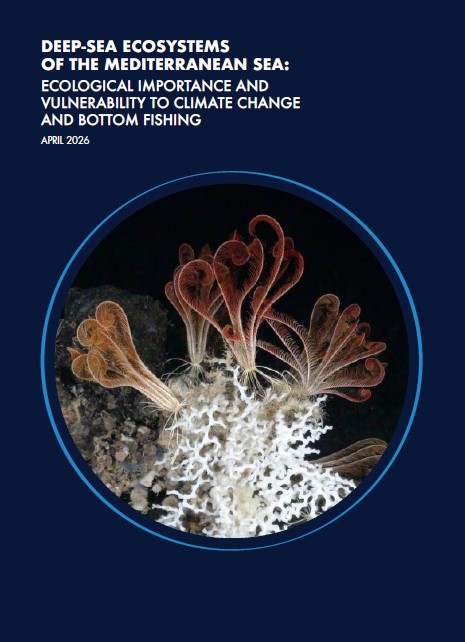
Mediterranean deep-sea ecosystems, particularly those between 600 - 1 000 m depth, are among the region’s most ecologically valuable yet vulnerable environments.
They host a mosaic of habitats, including cold-water coral reefs, sponge grounds, sea pen fields, bamboo coral (Isidella elongata) facies, submarine canyons, seamounts, and extensive soft-sediment plains. These systems support high biodiversity, important commercial species, and increased climate resilience, as natural, long-term reservoirs where carbon is stored. They are also highly vulnerable and slow to recover from damage, because they comprise slow-growing, long-lived species, with limited resilience to disturbance.
Bottom-contact fishing remains the most pervasive pressure on these habitats. In particular, bottom trawling removes habitat-forming species, alters sediment structure, and disrupts key linkages between the seafloor and the water column, with long-lasting impacts on ecosystem functioning and carbon burial. Evidence from the Mediterranean Sea shows that repeated bottom trawling leads to habitat degradation, reduced biomass of commercially important species, and loss of vulnerable marine ecosystems (VMEs). The Critically Endangered bamboo coral Isidella elongata, once widespread, now occurs only in scattered low-density populations due to trawling impacts.
Climate change is amplifying these pressures. Warming waters, deoxygenation, acidification, and reduced food supply are already affecting deep-sea species, with the Mediterranean warming faster than the global ocean. Habitat suitability models project significant declines in key VME taxa under high-emission scenarios, with suitable habitats shifting deeper and shrinking in several sub-regions. These trends threaten the long-term stability of deep-sea ecosystems and the fisheries they support.
Despite their vulnerability, deep-sea habitats may function as climate refugia, due to their relatively stable environmental conditions. However, this potential depends on maintaining ecological integrity. Degraded habitats lose structural complexity, functional redundancy, and carbon -storage capacity, reducing their ability to buffer climate impacts.
For the Mediterranean basin, strengthening deep-sea protection is both scientifically justified and strategically important, starting from banning trawling below 600 - 800 m depth.

